Friday, 7 January 2011

3D Scanners and Computer Aided Design (CAD)

3d scanner
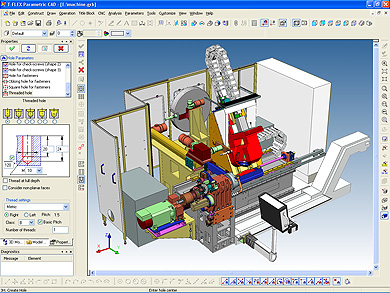
You may have heard this term “computer aided design” or “CAD” being spoken about but what actually is it? Let’s take a look.

Computer aided design, also known as CAD, is the use of computer technology in regards to the process of design and design-documentation.

Computer aided design can be used to design curves and models in two-dimensional. It can also be used to design curves, surfaces, and models in three-dimensional objects too.

What is Computer aided design used for?

Computer aided design is used usually alongside a 3D scanner in the design of tools, equipment and machinery and in the planning and design of all types of buildings. These buildings could be anything from small residential houses right up to the largest commercial and industrial structures such as hospitals and factories.

Computer aided design and a 3D scanner would mainly be used for detailed engineering of 3D models or physical components, but it is also used throughout the design process from the initial concept and first layout of products and right through. It can also be used to design objects and parts.

What are the different types of computer aided design?

There are several different types of computer aided design. Each of these different types of computer aided design systems requires the operative to think differently about how he or she will use them and he or she must design their virtual parts in a different way depending on what they are designing. There are many makers of the low-end 2D systems. There are also a lot of free programs available online.

These provide an attitude to the drawing process without all the hassle over scale and placement on the drawing sheet that accompanied hand drafting, since these can be attuned as required during the creation of the final draft. Top end systems offer the capabilities to incorporate more natural, aesthetics and ergonomic features into designs. There are also a number of very high end software packages that cost quite a lot of money and can only really be considered by serious businesses.

The use of computer aided design or that of a 3D scanner has become invaluable in the area of design today. Models are able to be made, shapes and surfaces can be measured quickly and efficiently which in turn means all necessary improvements can be made.

For more information see 3D Scanner

Friday, 3 December 2010

What Is Reverse Engineering?

reverse engineering
The clue is in the name in terms of reverse engineering. It's a means of figuring out the technical concepts and mechanics of an product or item by way of analyzing the structure, functionality and operations.

Often reverse engineering entails scanning a product so that you can replicate a perfect 3 dimensional duplication. For that reason, 3d scanning technologies are available straight into play, it may include both white light scanners, 3d scanners and CMMs.

Essentially an object or machine is taken and stripped down layer by layer with every single layer getting analysed till the entire operation and performance of the unit is understood. By doing this the item could be remade or perhaps the original could be improved upon.

The strategy of reverse engineering has been utilized quite a lot within the military services. Just one of such examples could be thedesign and style of the jerry can. In the Second World War the British military pointed out that the German’s jerry cans were of a superior design and build when compared with their own. Thus, they seizedone or two and employed reverse engineering to learn how they worked etc.

reverse engineering
As jerry cans were really a German invention called Wehrmachtskanister, the English name ‘jerry can’ occurred since they were stolen from Jerrys (Germans).

There are numerous purposes why reverse engineering is practical. Included in this are product analysis, digital correction, military surveillance and also foreducational functions. By working backwards we are able to see how a product worked when completed then go backwards to find out how this happens, as opposed to the standard route of beginning with nothing and working up.

Monday, 22 November 2010

The basics explaining White Light Scanning

White Light Scanning, typically named WLS, is a procedure employed to properly measure actual physical objects that would struggle to be assessed by more common procedures for instance a plane part, a grave or even a face.

As soon as the item is scanned a wholly exact three-dimensional photo will be generated that measures every last little bit of the items surface. By way of example, if a sheet of paper is scanned, an object you would imagine is quite even and even; it'll be capable to present to you every one of the teeny tiny bumps and ridges on the surface.

You might imagine thatsuch a product would have to be enormous as a way to scan stuff including tombs although this is not true.White light scanning machines are in reality relatively small. For the reason thatthey have to becarried to varied locations and quite often shifted around fixed objects as a way to scan every single inch of the object.

Many of the purposes of white light scanners areextremely serious. Including when a plane crashes or breaks as a result of a component of its composition breaking or even a bird flying in the engine, a scanner can certainly multiply a perfect copy of the sizes of the first piece. Exactly the same may be applied to the racing car sector. When objects are travelling so speedily and every little thing will depend on how wind resistant they are this is important.

So you can see, white light scanning is definitely an exciting topic and it has enabled us to properly measure an incredible volume of otherwise immeasurable, opening the way to a whole list of potential ideas and developments.